Tampilkan postingan dengan label Mathematic. Tampilkan semua postingan

Kamis, 23 April 2009

Contribution of Al-Khwarizmi to Mathematics and Geography

N. Akmal Ayyubi *

Introduction

Islam gave birth to a new civilization that spread from China in the east, India in the south east, Russia in the north, and Anatolia in the west of Asia, to East and North Africa until the mediteranean regions of Southern Europe. This civilisation was marked by a deep interest in science. In the heart of the Islamic scientific tradition lays the queen of sciences, mathematics, where the scholars of bilad al-Islam (lands of Islam) excelled in all its branches practiced in pre-modern times.

image alt text

Large image

Figure 1: A stamp issued in honour of al-Khwarizmi by the former USSR post in 1983. The text in Cyrilic reads: 1200 Years, Mukhammad al-Korezmi. (Source).

One of the greatest minds of the early mathematical production in Arabic was Abu Abdullah Muhammad ibn Musa al-Khwarizmi (b. before 800, d. after 847 in Baghdad) who was a mathematician, astronomer as well as a geographer and a historian. It is said that he is the author in Arabic of one of the oldest astronomical tables, of one the oldest work on arithmetic and the oldest work on algebra; some of his scientific contributions were translated into Latin and were used until the 16th century as the principal mathematical text books in European universities. Originally he belonged to Khwârazm (modern Khiwa) situated in Turkistan but he carried on his scientific career in Baghdad and all his works are in Arabic language. He was summoned to Baghdad by Abbasid Caliph Al-Ma'mun (213-833), who was a patron of knowledge and learning. Al-Ma'mun established the famous Bayt al-Hikma (House of Wisdom) which worked on the model of a library and a research academy. It had a large and rich library (Khizânat Kutub al-Hikma) and distinguished scholars of various faiths were assembled to produce scientific masterpieces as well as to translate faithfully nearly all the great and important ancient works of Greek, Sanskrit, Pahlawi and of other languages into Arabic. Muhammd al-Khwarizmi, according to Ibn al-Nadîm [1] and Ibn al-Qiftî [2] (and as it is quoted by the late Aydin Sayili) [3], was attached to (or devoted himself entirely to) Khizânat al-Hikma. It is also said that he was appointed court astronomer of Caliph Al-Ma'mun who also commissioned him to prepare abstracts from one of the Indian books entitled Surya Siddhanta which was called al-Sindhind [4] in Arabic [5]. Al-Khwarizmi's name is linked to the translation into Arabic of certain Greek works [6] and produced his own scholarly works not only on astronomy and mathematics but also in geography and history. It was for Caliph al-Ma'mun that Al-Khwarizmi composed his astronomical treatise and dedicated his book on Algebra.

Large image

Figure 2: Modern statue of al-Khwarizmi at Khiva, in Ouzbekistan. Photo Alain Juhel. (Source).

Contribution to Mathematics

Muhammad ibn Musa Al-Khwarizmi is one of the greatest scientific minds of the medieval period and most important Muslim mathematician who was justly called the 'father of algebra'. He wrote the Kitâb al-Jem wa'l Tafrîq bi Hisâb al-Hind also called Kitâb Hisâb al-adad al-Hindî on arithmetic in which he used Indian numerals [7] including zero in place of depicting numbers by the letters of the alphabet and the decimal notations or numeration by position" for the first time. It deals with the four basic operations of addition, subtraction, multiplication and division as well as with both common and sexagesimal fractions and the extraction of the square root. The original Arabic text of the book is lost and its only Latin translation is available.
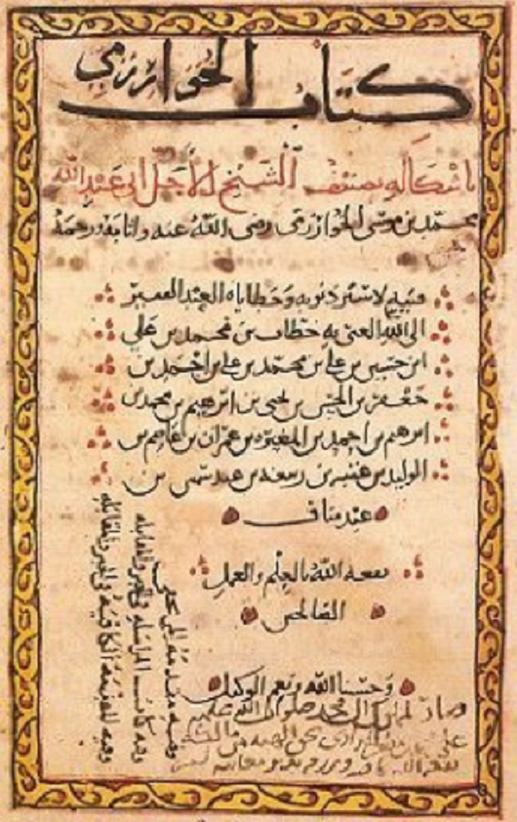
image alt text

Large image

Figure 3: Title page of an Arabic manuscript copy of al-Khwarizmi's Kitab al-jabr wa-'l-muqabala (Source).

Other mathematical writings of al-Khwarizmi are also not known. His best known classical work on algebra is the Kitâb al-Mukhtasar fî Hisâb al-Jabr wa'l-Muqâbala. It was translated into Latin in the Middle Ages and holds an eminent place in the history of mathematics. According to the words of Galal S.A. Shawki [8], in this book al-Khwarizmi defined algebra as an independent disciple in mathematics, and accelerated the introduction of the Arabic place value numbering into the West. The book is devoted to finding solutions to practical problems which Muslims encountered in daily life [9] concerning matters of inheritance, legacies, partition, lawsuits and commerce, with over eight hundred examples. The original work in Arabic was written in 820 CE [10]. and was translated into Latin in the 12th century. It is worth remarking that the term al-jabr, in the Latinized form of algebra, has found its way into the modern languages, whilst the old mathematical term algorism is a distortion of al-Khwarizmi's name.

The meaning of the Arabic word Al-Jabr is restoration by transposing negative quantities to the other side of the equation to make them positive; and the term Al-Muqâbalah refers to the process of eliminating identical quantities from the two sides of the equation [11]. But the best translation for Hisâb al-Jabr wa'l-Muqâbala, according to John K. Baumgart [12], is 'the science of equations'. The algebra of al-Khwarizmi was rhetorical in form. Al-Khwarizmi had given the rules for the solution of quadratic equations which are supported in a number of cases by geometrical proofs also. The unknown quantity, in the words of Galal S.A. Shawki, was termed the "thing" (shay') or "root" (jidhr); the latter means in Arabic the origin or base, also the root of a tree, hence, the use of the expression "root of an equation" is derived from this Arabic concept [13]. Al-Khwarizmi had used the Arabic word for root to denote the first degree term of a quadratic equation. Explaining in detail he says: "the following is an example of squares equal to roots, a square is equal to 5 roots. The root of the square then is 5, and 25 forms its square, which of course equals 5 of its roots [14]." For the second power of a quantity he employs mâl (wealth, property) which is also used to mean only "quantity" and dirham is used as unit of coinage.

Large image

Figure 4: Manuscript copy of al-Khwarizmi's book of algebra; the MS was copied in 743 H in Cairo, 500 years after the death of al-Khwarizmi. © Oxford University, the Bodleian Library.

The bases of algebra, first viewed as an independent mathematical discipline, were laid down by al-Khwarizmi who carefully formulated analytical solutions of the various forms of quadratic equation and profusely illustrated his method of solution by practical examples [15]. He was quite aware of the existence of two roots of the quadratic equation, though he cared for positive, real roots only [16].

The book Hisâb al-Jabr wa'l-Muqâbalah is actually on applied mathematics. Its first part discusses the equations of the first and second degrees. All his proposed problems can be reduced to one of the six standard forms. He gives rules for the solution of each of the six forms and explains how to reduce any given problem to one of these standard forms with examples [17]. The second part of the book deals with practical mensuration by giving rules for finding the area of various plane figures including the circles, and for finding the volume of a number of solids including cones and pyramids. The third part concerns legacies as well as inheritance and is the longest. It consists entirely of solved problems which arise out of legacies.

Large image

Large image

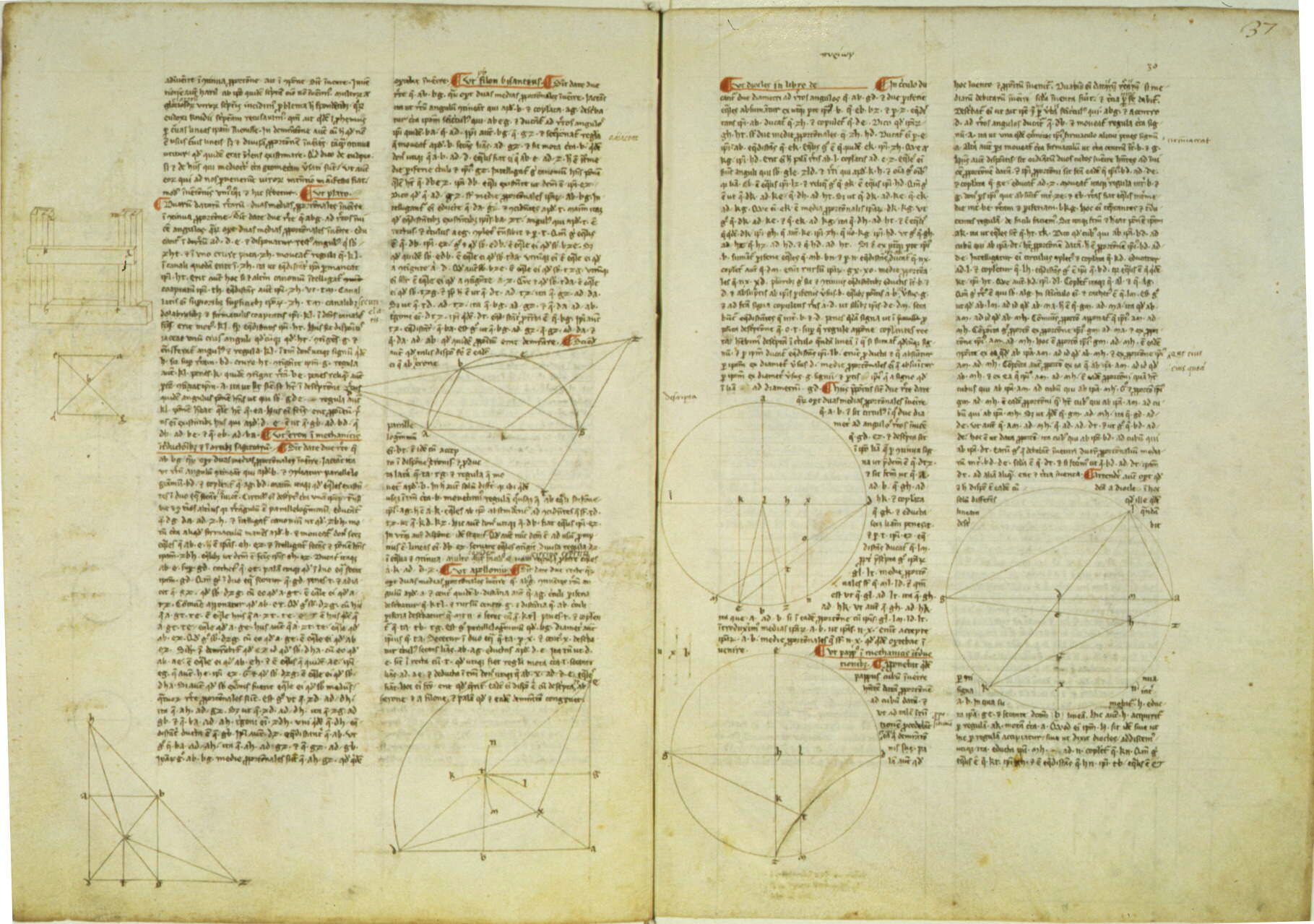
Figure 5: Incipit of a Latin manuscript of the tradition of algebraic and arithmetic books known as Algorismus : Pennsylvania University, Lawrence J. Schoenberg Collection, Manuscript Number: LJS 027, 115 folios. Illuminated for a member of the Albertini family of Nola, Italy, in 1478. (Source).

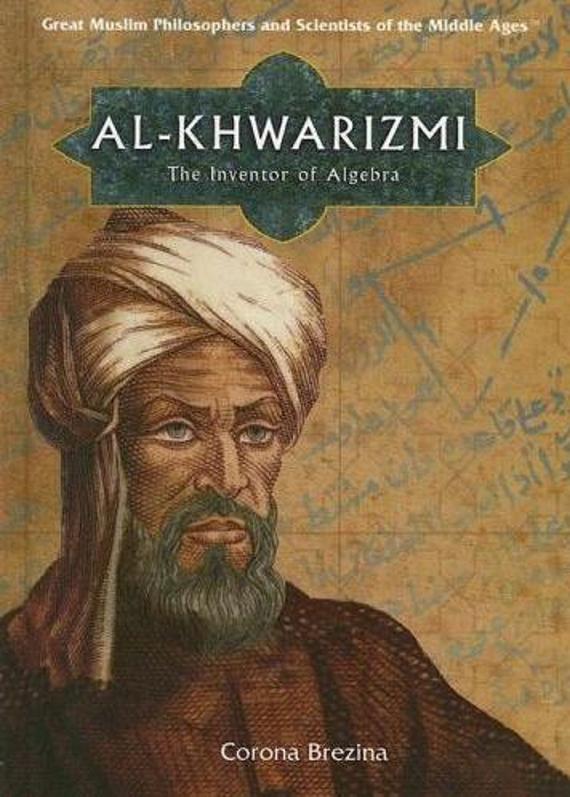
Figure 6: Front cover of Al-Khwarizmi: The Inventor Of Algebra by Corona Brezina (Rosen Central, 2006).

The mathematical works of al-Khwarizmi were used in European universities up to the 17th century. He is, in the words of 'Ali 'Abdullah Al-Daffa [18], the founder of algebra and had transformed the concept of a number from its earlier arithmetic character as a fixed quantity into that of variable element in an equation. He also found a method to solve general equations of the first and second degree in one unknown by both algebraic and geometric means [19]. It was through his work on mathematics that the Indian system of numeration was known to the Arabs and later through its Latin translation to the people of Europe. He synchronized Greek and Indian mathematical knowledge but was the first mathematician to distinguish clearly between algebra and geometry and gave geometrical solutions of linear and quadratic equations.

Large image

Figure 7: Two instances of the modern application of algebra: a book of algebra for electronic circuits and a pocket calculator.

Contribution to Geography

Al-Khwarizmi had also contributed to the science of geography. As the book of Geography of Claudius Ptolemy (2nd century CE) was translated several times into Arabic, he had a model for writing his book in this field of knowledge. His book on geography entitled Kitâb Sûrat al-Ard (Book of the image of the earth) consists almost entirely of lists of longitudes as well as latitudes of localities and gives in a tabulated form the coordinates of the places like cities, mountains, seas, rivers, islands etc. The book is arranged according to the Greek system of the seven climes (aqâlim) giving contemporary data but the knowledge acquired by the other Muslims are also incorporated into it. The first section lists cities, the second, mountains (giving the coordinates of their extreme points and their orientation); the third, seas (giving the coordinates of salient point on their coastlines and a rough description of their outlines); the fourth, islands (giving the coordinates of their centres, and their length and breadth); the fifth, the central points of various geographical regions; the sixth, rivers (giving their salient points and towns on them) [20]. This book had served as a basis for later works and stimulated geographical studies and the composition of original treatises. It is said that his Kitâb Sûrat al-Ard was also accompanied by regional maps of each of the climes and by a single world map called "al-Sûrat al-Ma'muniyya" but have been lost. It is also said that his map of the world was the first map of the heavens and the world drawn by Muslims. But the editor of the Kitâb Sûrat al-Ard Hans von Mzik, has produced only four maps. These four maps, in the words of S. Maqbul Ahmad [21], seem to be later recessions of the original maps. But Ibrahim Shawkat [22] argues that since Al-Khwârazmî wrote a brief work on geography, he did not draw a complete map of the world but confined himself to draw only the four maps as an illustration. His source of inspiration might possibly have been the mappa mundi [23] constructed for Caliph Al-Ma'mun by a team of geographers in which Al-Khwârazmî himself would have been included [24].

image alt text

Large image

Figure 8: A map by Abu Zaid Ahmed ibn Sahl al-Balkhi (850-934), a Persian geographer who was a disciple of al-Kindi and also the founder the "Balkhī school" of terrestrial mapping in Baghdad. Picture displayed on "Old Manuscripts and Maps from Khorasan". (Source).

The Kitâb Sûrat al-Ard depends, even if in an indirect manner, on the Geography of Ptolemy [25], but in the opinion of Ibrahim Shawkat, it was based on the work of Marinus [26]. The book was produced under the patronage of the Caliph Al-Ma'mun in about 830 CE in which the towns and mountains are presented in a tabulated form, and oceans, seas, islands, countries, springs and rivers are given in a descriptive form. Again, towns, mountains, springs and rivers are described according to the climes (aqâlim) to which they belong, while the description of the oceans and seas is free from the limits of these climes. Similarly islands are described under the seas and oceans to which they belong. The description of the countries is also free from the limits of the climes. Along with the geographical names of the Muslim period, a large number of ancient place names are also founded in the book but in the later portions these names rapidly begin to disappear.

The map of the world of al-Khwarizmi called al-Sûrat al-Ma'muniyya has now been fully reconstructed by an Indian scholar, Dr. S. Razia Jafri [27], on the basis of description and data given in his Kitâb Sûrat al-Ard. It is divided into 38 sections which are again sub-divided into 1740 small squares from West to East and into 1200 small squares "from South to North. Each clime (iqlîm) from West to East is again divided into seven sections. It is to be noted that the general division of the Map into climes is according to al-Khwarizmi, but the sub-division of the climes into section is done by Dr. Razia Jafri arbitrarily. In this way it is just like an Atlas. It is to be noted that the Soviet Academy of Sciences of Tajik is publishing it along with the forward and introduction of Dr. Kamal Ayni and Prof. S. Maqbul Ahmad respectively. The printing of this work is done under the supervision of Prof. M.S. Asimov who was the eminent scholar and the president of the Academy of Sciences of the former Soviet Tajik Republic at Dushanbe.

image alt text

Large image

Figure 9: Map of South Caucasus drawn ca. 950 CE by the geographer al-Istakhri in his Kitab al Masalik wa-al-Mamalik (Book of roads and provinces), showing Armenia with Mount Ararat, Lake Van and Azerbaijan. The map shows. Printed in Maps of Ancient Armenia by Roubik Galichian (London, 2004). (Source).

Al-Khwarizmi is the author of several other books on astronomy and history. He became well known as a mathematician and it is said that he is the author of the oldest work on algebra. But the late Professor Aydin Sayili says in one of his research papers entitled "Turkish contribution to Science" as follows: "Abu'l Fadl cAbdulhamîd ibn Wâsic ibn Turk was apparently the first Islamic mathematician to write a book on algebra. Indeed, he, very likely, wrote his algebra before Al-Khwârazmî wrote his. For unlike Al-Khwârazmî, he did not write an unabridged algebra, and, moreover, there is evidence that Al-Khwârazmî was still alive at about the middle of 9th century. cAbdulhamîd ibn Turk was also the author of certain books on numbers, on commercial arithmetic, and on the art of calculation, probably with the decimal system. Now, it is not possible for me to agree or disagree with him but it is realistic to say that the works of al-Khwarizmi on mathematics have great influence in the birth of Western Science and he is rightly called the "father of algebra" and a peerless geographer [28]."

Large image

Figure 10: A world map by al Istakhri (934 CE). The map is oriented with South at the top. Picture displayed on "Old Manuscripts and Maps from Khorasan". (Source).

References and further reading

  • Adivar, Abdulhak Adnan, "Harizmi" in Islam Ansiklopedisi, vol. 4, p. 261.
  • Fihrist al-Ulûm, edited by Flügel, vol. 1, 1871, p. 274.
  • Historical topics for the Mathematics Classroom, Washington 1969.
  • Hocker, Sidney G., and others, Fundamental Concepts of Arithmetic, 1963, p. 9.
  • Hogbin, Lancelot, Mathematics for the Million, New York 1946, p. 291.
  • Jones, Philip S., "Large Roman Numerals", The Mathematics Teacher, vol. 28, p. 261.
  • Khara'it Jughrafiqyyi al-'Arab al-awwel, Majallet al-Ustadh of Baghdad, 1962, pp. 7-8.
  • Kokomoor, Franklin W., Mathematics in Human Affairs, New York 1946.
  • Ronart, Stephen and Nandy, Concise Encyclopaedia of Arabic Civilization, New York I960, p. 295.
  • Sayili, Aydin, "Turkish Contributions to Scientific Work in Islam", Belleten (Turkish Historical Society), vol. 43, Ankara 1979, s. 16.
  • Sayili, Aydin, The Observatory in Islam, Ankara 1960.
  • Shawki, Galal S.A., Formulation and Development of Algebra by Muslim Scholars, published in Islamic Studies of Islamabad, vol. 23, No. 4, p. 338.
  • Tafkir al-cArab al-Jughrafi wa'itaqat al-Yunan bihi", extract from the Journal "A l-Ustadh", Baghdad 1961.
  • Tarikh al-Hukama, edited by Lippert, Berlin 1903 (Cairo edition, 1326 H), p. 286.
  • The Muslim Contribution to Mathematics, London 1977, p. 7.
  • Toomer, G.J., "Al-Khwârazmî", Dictionary of Scientific Biography, vol. 7, pp. 359-361.
  • Turkish Architecture, translated by Prof. Dr. Ahmet Edip Uysal Ankara 1965, p. 2.
  • Zemanek, Heinz, "DIXIT Algorizmi - His Background, his Personality, his Work, and his Influence". Source Lecture Notes In Computer Science, vol. 122. Proceedings on Algorithms in Modern Mathematics and Computer Science. Berlin: Springer-Verlag, 1979 , pp. 1 - 81.

End Notes

[1] Fihrist al-Ulûm, edited by Flügel, vol. 1, 1871, p. 274.
[2] Tarikh al-Hukama, edited by Lippert, Berlin 1903 (Cairo edition, 1326 H), p. 286.
[3] Aydin Sayili, The Observatory in Islam, Ankara 1960, p. 55.
[4] Abdulhak Adnan Adivar, "Harizmi" in Islam Ansiklopedisi, vol. 4, p. 261.
[5] It was first introduced in Baghdad by an Indian traveller in 771 CE, which by order of al-Mansur was translated into Arabic by Muhammad ibn Ibrahim al-Fazârî between 796 and 806 for the first time.
[6] Stephen and Nandy Ronart, Concise Encyclopaedia of Arabic Civilization, New York I960, p. 295.
[7] Ya'qub bin Tariq is said to be the first Muslim to introduce Indian numbers to Arabs.
[8] Galal S.A. Shawki, Formulation and Development of Algebra by Muslim Scholars, published in Islamic Studies of Islamabad, vol. 23, No. 4, p. 338.
[9] Lancelot Hogbin, Mathematics for the Million, New York 1946, p. 291.
[10] Sidney G. Hocker and others, Fundamental Concepts of Arithmetic, 1963, p. 9.
[11] Galal S.A. Shawki, Formulation and Development of Algebra…, op. cit., p. 338.
[12] Historical topics for the Mathematics Classroom, Washington 1969, pp. 233-4.
[13] Islamic Studies of Islamabad, vol. 23, No. 4, p. 339.
[14] Philip S. Jones, "Large Roman Numerals", The Mathematics Teacher, vol. 28, p. 261.
[15] Islamic Studies of Islamabad, vol. 23, No. 4, p. 351.
[16] Ibid.
[17] G.J. Toomer, "Al-Khwârazmî", Dictionary of Scientific Biography, vol. 7, p. 359.
[18] The Muslim Contribution to Mathematics, London 1977, p. 7.
[19] Franklin W. Kokomoor, Mathematics in Human Affairs, New York 1946, p. 172.
[20] G.J. Toomer, "Al-Khwarizmi", Dictionary of Scientific Biography, volume 7, p. 361.
[21] Encyclopaedia of Islam, (new edition), vol. 4.
[22] Khara'it Jughrafiqyyi al-'Arab al-awwel, Majallet al-Ustadh of Baghdad, 1962, pp. 7-8.
[23] Mappa Mundi is a term used for the map of the world.
[24] Encyclopaedia of Islam, vol. 4, p. 1078.
[25] Ibid.
[26] Tafkir al-cArab al-Jughrafi wa'itaqat al-Yunan bihi", extract from the Journal "A l-Ustadh", Baghdad 1961.
[27] One of the staff members of Aligarh Muslim University of India.
[28] Aydin Sayili, "Turkish Contributions to Scientific Work in Islam", Belleten (Turkish Historical Society), vol. 43, Ankara 1979, p. 16.Click here.

*Dr., Department of Islamic Studies Aligarh Muslim University, Aligarh, India. This article was first published in the Proceedings of the International Symposium on Ibn Turk, Khwârazmî, Fârâbî, Beyrûnî and Ibn Sînâ (Ankara, 9-12 September 1985), Ankara, 1990.

by: FSTC Limitied, Wed 27 December, 2006


source: MuslimHeritage.com

The Volume of the Sphere in Arabic Mathematics: Historical and Analytical Survey

By Professor Dr. Mustafa Mawaldi1

Table of contents

1. Introduction
2. Historical survey
2.1. The volume of the sphere in Greeks mathematics: Archimedes
2.2. The volume of the sphere in Chinese mathematics
3. The volume of the sphere in Arabic mathematics
3.1. Banu Musa
3.2. Abu ‘l-Wafa al-Buzgani
3.3. Al-Karaji
3.4. Ibn Tahir al-Baghdadi
3.5. Ibn al-Haytham
3.6. Ibn al-Yasamin
3.7. Ibn al-Khawwam
3.8. Kamal al-Din al-Farisi
3.9. Al-Kashi
3.10. Bahā' al-Dīn al-'āmilī
4. Conclusion

* * *

Abbreviations
  • The diameter = d
  • The radius = r
  • The periphery = p
  • The area of sphere surface = s
  • The area of the greatest circle in the sphere = S1
  • Volume of the sphere = v
  • Volume of right-cone = V1
  • The area of cone-base = S4
  • Cone height = H4
  • Volume of a right-cylinder = V2
  • The area of the cylinder base = S2
  • The cylinder height = H2
  • The area of the side surface of a circular right-cylinder = S3
  • Volume of the cube = V3
  • Volume of vertical ring = V4
1. Introduction


image alt text

Large image

Figure 1: A sphere circumscribed in a cylinder: the sphere has two thirds of the volume and surface area of the circumscribing cylinder.

The mathematicians of the Arabic civilization endeavoured to find a rule through which the sphere volume can be calculated. Some of them had got a cubic measure of it in comparison with the known volume of solids such as the cone, the cylinder, and so on. Likewise, they obtained a figure of the volume by finding out a relationship that links the elements of the sphere such as its surface to its radius. Consequently, the value of π played an important role in the accuracy of the cubic measure. Thus, some of the mathematicians of the Islamic tradition had the right measure, whilst others had the wrong one and proposed erroneous values.

Basically, this research is concerned with the cubic measure of the volume of the sphere in the mathematical tradition of the Arabic civilization. We begin by surveying the ancient contribution with a presentation of Archimedes' results in the Greek tradition on this issue, besides a survey of the development of cubic measure of sphere in Chinese mathematics. The fundamental points of our study discuss the following subjects. After a historical introduction on the volume of the sphere in Greek and Chinese mathematics, we present a thorough survey of the same topic in the mathematics of the Arabic-Islamic civilization from the 9th to the 17th century, especially in the works of Banu Musa, Abu ‘l-Wafa al-Buzgani, Al-Karaji, Ibn Tahir al-Baghdadi, Ibn al-Haytham, Ibn al-Yasamin, Al-Khawam al-Baghdadi, Kamal al-Din al-Farisi, Jamshid al-Kashi, and Baha' al-Din al-‘Amili. Finally, a set of conclusions is deduced.

2. Historical survey
2.1. The volume of the sphere in Greeks mathematics: Archimedes

image alt text

Large image

Figure 2: Two manuscript pages of the Greek text of Archimedes' Sphere and Cylinder (Source).

The mathematical problem of the measure of the volume of the sphere is discussed by Archimedes in his known book The Sphere and Cylinder. Archimedes is considered as the best Greek scientist in the fields of mathematics and mechanical engineering. He died in 212 BCE. His scientific legacy consists in a group of influential texts presenting several important theories [2].

His book The Sphere and Cylinder [3] is composed of two parts. In the first one, Archimedes presented a number of definitions and postulates. Then he discussed the surfaces and volumes of some solids, such as the surface area of the sphere as well as its volume. In the second part, he developed some constructions and demonstrations related to the theories that he had mentioned in the first part.

Archimedes gives a rule of the volume of the sphere in comparison with the cone and cylinder. In the words of Nasir al-Din al-Tusi's edition and recension of his book The Sphere and Cylinder, Archimedes' first formula is formulated as follows:

"Each sphere is equal to four times a cone whose base is equal to the greatest circle in that sphere, and the height [of this cone] is equal to the radius of that sphere. [4]"

We may write such a rule as follows: V = 4V1; assuming that S1 = S4 and r = H4. This formula corresponds to the eighth formula of Al-Kashi, as we will see below.

Afterwards, Archimedes expressed the second formula as follows:

"Each cylinder of which the base is equal to the greatest circle that exists in a sphere, and its height is equal to the diameter of its base, [such a cylinder] is equal to one and a half of the sphere [5]."

That is, in symbolic language: 3/2V = V2; assuming that S1 = S2 and d = H2. This formula corresponds to the seventh formula of Al-Kashi.

In the Arabic edition of Archimedes' treatise composed by Nasir al-Din al-Tusi, we find the complete demonstration of these two formulas [6]. In addition, the modern mathematical analysis of the Archimedean theorem of the volume of the sphere is developed by Marshall Clagett in his article on Archimedes in the Dictionary of Scientific Biography [7].

2.2. The volume of the sphere in Chinese mathematics

image alt text

Large image

Figure 3: Modern imaginary portrait of the mathematician Muhamad al-Bujzani known as Abu ‘l-Wafa (940-997 CE) (Source).

The book of The Arithmetic Art in Nine Chapters (jiuzhang suanshu) by an unknown author is considered as an important source of Chinese mathematics. It was probably collected in the 1st century CE and was used by Chinese mathematicians as an essential source until the 13th century CE [8].

The Chinese gave special interest to the cubic measure of the volume of the sphere. Thus, we find in the fourth chapter of The Arithmetic Art in Nine Chapters two problems related to the calculation of the diameter of a sphere that has a definite volume, then, the solution was obtained by finding the following cubic- root:

[(16/9) V]1/3.

We may formulate the above relation as follows: V = (9/16)d3. Certainly, this is a wrong formula of the cubic measure of the volume of the sphere, as it is greater than the real volume by the amount (13/336 d3).

The historians refer the origin of that formula to different sources and analyses such as:

1. The practical method: An unknown interpreter of the book The Arithmetic Art in Nine Chapters reached the above formula by a trial of the cubic measure as follows: a cubic weight of copper, its diameter being one inch/+/16x200g, and the weight of a sphere of copper having a diameter 9x200g; from here the two numbers 16 and 9 were deduced.

Besides, it is curious to find that the theory of the practical method to make a cubic measure of the volume of the sphere of Al-Karaji corresponds to the practical method used in the Chinese treatise, although it differs from it in certain details, as the Chinese mathematician made the diameter of the sphere equal to a cube diameter, whilst Al-Karaji made the diameter of the sphere equal to one side of the cube. Consequently the volume of the sphere in the Chinese treatise by the practical method was greater than the real volume –as mentioned above– by the amount of (13/336 d3); whilst the volume of the sphere in Al-Karaji by the practical method was greater than the real volume by the amount of (31/315 d3).

Both approaches led to a greater value than the exact one for the calculation of the volume of the sphere, but the Chinese practical method is closer to the real volume of the sphere. We need to mention here that we don't know the history of the Chinese practical method.

2. The value of π. Some historians of mathematics [9] link the original formula found in the Chinese calculation of the volume of the sphere to the history of π value. Hence, the author of the Arithmetic Art in Nine Chapters would use π with the value 25/8. Actually, the value of π in this book is considered roughly as 3 in general.

Finally, we find that the Chinese author made a thorough study and after several arduous attempts got the formula of the correct volume of the sphere.

3. The volume of the sphere in Arabic mathematics

3.1. Banu Musa

image alt text

Large image

Figure 4: Figures of the geometrical proof of the Pythagorean theorem by Abu ‘l-Wafa al-Buzgani and its application in ornamental tiles: two equal squares are easily combined into a bigger square; Abu ‘l-Wafa's method works even if the squares are different (Source).

The three brothers Banu Musa, who flourished in Baghdad in the 3rd century H/9th century CE, studied the volume of the sphere in their well known mathematical treatise Kitab ma'rifat masahat al-ashkal al-basita wa-‘l-kuriya (Book about the knowledge of the area of plain and spherical figures).

The book consists in an introduction and eighteen theorems. In general, the book investigates the rules to calculate the areas of the spherical and plane surfaces with their volumes. It also discusses a set of geometric problems such as the division of angles into three equal portions, placing two quantities between two quantities in order to create series of one proportion. Hence, the book includes a method to find the approximate cube root of any figure required by the calculator [10].

The book is ascribed to the three brothers Banu Musa Muhammed, Ahmed, and Al-Hasan, who were known as the Banu Musa. They excelled in mathematics, astronomy, mechanics, music, and philosophy. They were among the best Muslim scientists during the 3rd century H / the 9th century CE. As a result of our recent study of the book, we mostly relate it to the three brothers in common, but Al-Hasan, the mathematician of the group, had the biggest share in its authorship [11].

Banu Musa gave a rule of the volume of sphere, then they proved it in the 15th theorem of their book. We present hereinafter this theorem:

[Theorem 15]: "For each sphere, the product of multiplying its radius in the third of the area of the sphere surface is equal to its volume [12]."

As a result of this statement, Banu Musa gave the correct rule of the volume of the sphere as follows: V = 1/3 r.(S). Thereafter, this theorem was considered as identical with Abu ‘l-Wafa al-Buzgani's second formula for the volume of the sphere. It was also mentioned by Ibn Tahir al-Baghdadi, and it corresponds to the first formulas of Al-Kashi and Al-‘Amili, as we shall see later. Furthermore, the Banu Musa used the proof by contradiction (also known as burhan al-khulf or reductio ad absurdum) to prove the rightness of the above mentioned formula. Before them, Archimedes gave the volume of sphere with reference to the volume of the cone. He said:

"Each sphere has four times the volume of a cone of which the base is equal to the greatest circle that may be inscribed in that sphere and of which the height is equal to half the radius of that sphere [13]."

Accordingly, Al-Dabbagh confirms the importance of the assumption that Banu Musa defined the volumes like magnitudes and not by comparing them with other volumes as Archimedes did. In other words, they used arithmetic operations to find the geometric magnitudes, and this approach may be considered as an important step to extend the numeric system so that it comprises natural as well as rational numbers [14].

On the other hand, Banu Musa's demonstration differs from that of Archimedes. This feature was remarked by Roshdi Rashed, who referred to it as a feature stressing the importance of the mathematical achievements of Banu Musa [15].

Also, we notice that Kamal al-Din al-Farisi depended on the book of Banu Musa so that he could correctly find the volume of the sphere. He corrected the wrong formula used to measure the volume of the sphere in his time, referring to the 15th theorem in the book of Banu Musa [16].

3.2. Abu ‘l-Wafa al-Buzgani

image alt text

Large image

Figure 5: General view of the western and southern courtyards of the Friday Mosque in Isfahan where Abu ‘l-Wafa's figure is applied (Source).

Abu ‘l-Wafa al-Buzgani (328 H/940 CE–388 H/998 CE) is an important mathematician of Islam. He is the author of Kitab fi ma-yahtaju ilayhi al-kuttab wa-‘l-‘ummal wa-ghayruhum min ‘ilm al-hisab (Book in what is needed by secretaries, artisans and others in the science of arithmetic). Known as Abu al-Wafa al-Buzgani, his full name is Muhammad b. Muhammad b. Yahya bin Isma'il bin Al-‘Abbas. He was born in Buzgan, in the region of Nishabur in Kuhistan, Iran, in Ramadan 328 H (940 CE), and he moved to Iraq in 348 H/959 CE. He then lived in Baghdad where he wrote the above mentioned mathematical book in addition to numerous other works in mathematics and astronomy. He died in Baghdad in 388 H/998 CE [17].

Al-Buzgani divided his book into seven parts or chapters devoted to the following subjects: the proportion, multiplication and division, surveying, taxation, division of inheritances, several varieties of arithmetic that are needed by secretaries (state employees), and calculations for commercial transactions [18].

Concerning the volume of the sphere, Al-Buzgani gave a rule that he included in the chapter on the surface area of the cone. He states:

"We get the surface area of a sphere by multiplying by four the area of the greatest circle inside it, the resultant is the surface area of the sphere. As for the surface area of the solid, Archimedes used to multiply the diameter of the sphere in itself and he added the periphery of the greatest circle on it, then he takes its sixth; the result is the surface area of the sphere. Another method: we obtain the area of the sphere by multiplying the diameter of the greatest circle that exists on it by the periphery of that circle, the product will be the area of its surface. Furthermore, we get the surface area of the solid by multiplying the third of the surface area by the radius of the sphere, the product will be the surface area of the sphere [19]."

Consequently, Al-Buzgani gives a rule for the volume of a sphere by two correct formulas:

1. The first formula: Before giving the first formula, Al-Buzgani gives the surface area of the sphere as follows: S =4S1. Then, he gives the rule of the volume of the sphere referring to Archimedes: V = 1/6 d2.p. This formula corresponds to the fifth formula of Al-Kashi.

2.The 2nd formula: Then Al-Buzgani gives, first, the surface area of the sphere surface, then its volume. The surface area of the sphere is S = d.P; the rule of the volume of the sphere is V = 1/3 S.r. This formula corresponds to the first one of Al-Kashi; it was also mentioned by Banu Musa who proved it.

3.3. Al-Karaji

image alt text

Large image

Figure 6: Two cases of the theorem of Al-Kashi or the law of cosines applied in the case of an unknown side and unknown angle by the method of "cutting and pasting". In trigonometry, Al-Kashi's law or the ‘cosine formula' is a statement about a general triangle which relates the lengths of its sides to the cosine of one of its angles (Source).

Abu Baker Muhammed ibn al-Hasan al-Karaji, lived in Baghdad, in the age of the king Fakhr al-Mulk Abu Ghaleb Muhammed bin Khalaf. Most sources indicated that he died around 419 H/1029 CE [20].

Al-Karaji discussed the problem of the volume of the sphere in his mathematical treatise Al-Kafi fi ‘l-hisab (The sufficient book in arithmetic) [21]. This book is particularly assigned to employees and to the public in general, and to those interested in the calculation of Islamic welfare (al-zakat) and legacies. While being of a prominent scientific level, the book was structured with methods that could be understood by those for whom it was written. Basically, Al-Karaji didn't use numbers such as the hand calculation of his age, but he expressed them by words. Moreover, the book was classified as one of by-hand calculation books. It discusses subjects such as arithmetic, geometry, and algebra.

Al-Karaji gave a rule for the volume of the sphere in the case of solids. He said:

"The third part: the sphere and its surface area. You should multiply its diameter in itself, then the sum is multiplied by the diameter, then you subtract the seventh and a half from the product, and you subtract the seventh and a half from the remainder. If you take a body of wax erected at right angles with three equal dimensions and you weigh to find it equal to thirty dirhams, then you make a solid sphere from it such that its diameter is equal to one side of the solid, so that you find that it weighs roughly less than eighteen and two-thirds, this requires that the diameter of sphere to be cubed and you subtract approximately a third and two fifths of its ninth from it. Consequently, we find a close distinction between the two works, but I believe that the first is the correct one [22]."

Al-Karaji gives the volume of the sphere by two methods: the first is theoretical, and the second is practical.

The theoretical method obtains the formula:

V = [d3 - (1/7+1/2.1/7)d3] – (1/7+1/2.1/7)[d3 - (1/7+1/2.1/7) d3];
i.e.: V = (11/14)2.d3.

When compared with the correct volume of the sphere (11/21).d3, we find that Al-Karaji's formula produces a value greater than the correct volume by the amount (55/588.d3).

Al-‘Amili [23] gives the same rule as Al-Karaji of the volume of the sphere, but Ibn Muhammed al-Khawam [24] credits the same wrong rule of the volume of the sphere mentioned by Al-Karaji. Furthermore, we find the following statement in the treatise Al-kafi fi ‘l-hisab: "The surface area of the sphere = (1 – 1/7 – 1/2.1/7), (the diameter) = (1 – 1/7 – 1/2.1/7)d3." Baha' al-Din al-‘Amili considers that the surface area of the sphere = 11/14. (the diameter)3 [25], that is = (11/14)d3 (note that the equation is not meant to be dimensionally correct). This contradicts what was mentioned by Al-Karaji in his book Al-kafi fi ‘l-hisab recently edited, and also what was mentioned by Al-‘Amili who said the following in this concern: "Or you subtract the seventh and a half of its seventh from the cube of the diameter, then do the same with the result [26]."

The practical method: with this method, we obtain:

V = d3 - (1/3 + 2/5.1/19)d3 = d3(1 – 1/3 – 2/5.1/9) = (28/45)d3. Comparing with the correct volume of the sphere, which is (11/21)d3, we find that the rule of the volume of the sphere of Al-Karaji with the practical method gives a value greater than the correct volume by the amount of (31/315)d3.

By comparison with the distinction of the first method and its amount (825/8820)d3 = (55/588)d3, with the distinction of the second method and its amount (868/8820)d3 = (31/315)d3, we may conclude that the rule of the practical method is more erroneous than that of the theoretical method. This is confirmed by Al-Karaji himself when he said: "There is a slight discrepancy between the two methods, and I believe that the first is the correct one". Thus, by calculating the distinction between the two methods we find it equal to the following amount: (868/8820)d3 - (825/8820)d3 = (43/8820)d3.

Finally, we note that Al-Karaji gives two rules to calculate the volume of the sphere, and both are wrong. Saidan mentions an opinion of an interpreter of the book of Al-Karaji about the volume of the sphere as follows [27]: "Al-Shahrzuri [28] justifies the first rule that the square of the circle is (11/14)d3, and thus the volume of the sphere should be 11/14.11/14.d3, and he objects to the amendment mentioned by Al-Karaji as it differs from what was stated by the ancients!"

3.4. Ibn Tahir al-Baghdadi

image alt text

Large image

Figure 7: Portraits of Ibn al-Haytham on two stamps issued by Qatar in 1971 and Pakistan in 1969 (Source).

Our mathematician Al-Baghdadi is Ibn Mansur Abdul Qahir bin Tahir b. Muhammed b. Abdullah al-Shafi'i al-Baghdadi. He is called a faqih. He died in 429 H/1037 CE. He was a scientist and an important scholar who wrote many books dealing with the science of fiqh (Islamic law), principles of jurisprudence (usul al-fiqh) and arithmetic [29]. He dealt with the volume of the sphere in his book Al-takmila fi ‘l-hisab (The completion of arithmetic).

The book comprises the following seven chapters of arithmetic: in the knowledge of Indian arithmetic figures, calculation on the board, whole numbers and revealing their numeric figures, calculating fractions figures, calculating degrees and minutes figures, hand calculation figures; particular sections of roots and cubes; the different properties of numbers, some specific arithmetic operations, on transactional arithmetic, and finally a chapter on base derivation [30].

Concerning the volume of the sphere, Ibn Tahir al-Baghdadi gives a rule of this mathematical problem in the chapter devoted to the area of solids (i.e., their volumes). He said:

"In order to know the volume of the sphere solid, third of surface area of the greatest circle on it should be multiplied by its radius, thus, all of its volume will be known by calculating the surface area related to this circle, as it is quarter to all of its area of sphere surface. Allah knows best [31]."

Specifically, the volume of the sphere is given as follows: V = (S).r/3, and this is a correct formula. Thus, to calculate the surface area of the sphere, Ibn Tahir al-Baghdadi gives the following connection: S1 = S.1/4 (assuming that S1 = the area of the greatest circle). Thus, Ibn Tahir al-Baghdadi defined the rule of the volume of the sphere in its correct form, and it is identical with that of Banu Musa for this mathematical problem.

3.5. Ibn al-Haytham


image alt text

Large image

Figure 8: Manuscript view of the opening of the mathematical poem of Abdullah ibn Muhammad Ibn al-Yasamin (d. 1202) al-Urjuzah al-Yâsamîniyya fî l-jabr (Source).

Risala fi misahat al-kura (treatise on the surface area of the sphere) is another treatise of Arabic mathematics in which the problem of the volume of the sphere is demonstrated. The text is due to the famous scientist Al-Hasan ibn al-Haytham, born in 965 CE and died 1039 CE. Ibn al-Haytham was creative in many fields from optics, mathematics, astronomy, to philosophy and divine sciences.

The treatise of Ibn al-Haytham on misahat al-kura is still unedited. It is extant in several manuscripts. One is a manuscript copy held at the National Algerian Library in Algiers under no.1446 (pp. 113r and 119v). The text consists in 14 manuscript pages, each page contains 21 lines. Another manuscript source of this treatise is preserved at Istanbul, Atif Library, under no. 1714/20 (pp. 211v-218r; 14 pages). Each page consists of 25 lines. The treatise comprises a proof of the formula for the volume of the sphere. Professor Ali al-Ayeb presented recently the proof of Ibn al-Haytham in two congress articles [32].

Ibn al-Haytham gives the formula of the volume of the sphere as follows:

"Each sphere is two thirds of a rounded cylinder of which the base is the greatest circle located in the sphere and its height is such as the diameter of the sphere [33]."

This relationship can be expressed in symbolic language as follows: (the volume of the sphere) V = 2/3 V2 (volume of the cylinder), the diameter of the sphere d being = height of cylinder H2, the area of the greatest circle in the sphere s1 = area of the base of the cylinder s2; thus, the volume of the sphere is:

V = 2/3 (V2) = 2/3 (πr2.H2) = 2/3 (S1.d).

By this transformation, we find that the above formula corresponds to the second formula of Al-Kashi.

Professor Ali al-Ayeb mentioned in the introduction to his study of the treatise of Ibn al-Haytham that his work "is related to one feature of the Arabic mathematical activities in infinitesimal quantities… This subject became subsequently a basic introduction of the chapter of integral calculus which provided easy solutions to many difficult problems and complicated operations, furnishing thus a great help to the [mathematical] discovery and invention [34]."

Footnotes

[1] Dean of the Institute for the History of Arabic Science, Aleppo University, Aleppo, Syria.

[2] Marshall Clagett, "Archimedes", Dictionary of scientific Biography, Charles Scribner's Sons, New York, 1970, vol. 1, pp. 213-232.

[3] Archimedes, Kitab al-kura wa-‘l-ustuwana (The book of the sphere and the cylinder), edited by Nasir al-Din al-Tusi, Haydarbad: Da'irat al-ma'arif al-‘Uthmaniya, 1359H. See also James Gow, A Short History of Greek Mathematics, Chelsea Publishing Company, N.Y., 1968, pp. 227-229; Marshall Clagett, "Archimedes", Dictionary of Scientific Biography, edited by C. Gillispie, New York: Charles Scribner's Sons, vol. 1, 1970, pp. 213-231.

[4] Archimedes, Kitab al-kura wa-‘l-ustuwana, op. cit., p. 65.

[5] Archimedes, Kitab al-kura wa-‘l-ustuwana, op. cit., p. 67.

[6] Archimedes, Kitab al-kura wa-‘l-ustuwana, op. cit., pp. 65-67.

[7] M. Clagett, "Archimedes", op. cit., pp. 220-221.

[8] Karine Chemla, "Theoretical Aspects of the Chinese Algorithmic Tradition (First to Third Century)", Historia Scientiarum, No . 42, (1991), p. 75.

[9] Martzloff, Histoire, op.cit, pp. 269-270.

[10] M. Mawaldi, "Ilm al-handasa inda abna' Musa bin Shaker" (Geometry of the sons of Musa Ibn Shaker), in The special book for the celebration of scientists Muhammad, Ahmad, and Al-Hasan, the sons of Musa Ibn Shaker, The 36th Science Week, Aleppo University, 2-7 Nov. 1996; Ministry of High Education, High Committee of Sciences, Damascus, 1998, pp. 99-125; p. 104.

[11] M. Mawaldi, "Ilm al-handasa inda abna' Musa bin Shaker", op. cit., pp. 100, 103.

[12] Banu Musa, Kitab ma'rifat masahat al-ashkal al-basita wa-‘l-kuriya (Book on the areas of of plane and spherical figures), edited by Nasir al-Din al-Tusi, published in Haydearabd by Da'irat al-ma'arif al-uthmaniya, 1359 H, p. 19; see also Banu Musa, Kitab ma'rifat masahat al-ashkal al-basita wa al-kuriya, University of Tehran, Heritage Institute Collection, 720, p. 133.

[13] Archimedes, Kitab al-kura wa-‘l-ustuwana, edited by Nasir al-Din al-Tusi, 1st edition, incl. messages of Al-Tusi, Haydarabad, 1359 H, p. 65.

[14] Dabbagh, "Banu Musa", Dictionary of scientific Biography, Charles Scribner's Sons, New York, 1970, vol. 1, pp. 444-445.

[15] R. Rashed, "Les autres disciplines mathématiques", Le Matin des Mathématiciens, Paris: Belin - Radio France, 1985, pp. 163-164.

[16] M. Mawaldi, L'Algèbre de Kamal al-Din al-Farisi. Édition Critique, Analyse mathématique et Étude historique, en 3 Tomes. Thèse du Nouveau Doctorat. Université Paris III, 1989, vol. 1, pp. 573-574.

[17] Saidan, Tarikh ‘ilm al-hisab al-‘arabi [History of the Arabic arithmetic]. Vol. 1: "Hisab al-yad" (hand calculation), a review to the book of "Al-manazil al-sab'a" (the seven arrangements) of Abu ‘l-Wafa al-Buzgani, with an introduction and a comparative study with Al-Kafi book in arithmetic of Al-Karji, Amman, 1971, pp. 58, 268.

[18] Saidan, Tarikh ‘ilm al-hisab al-‘arabi, op. cit., p. 65.

[19] Saidan, Tarikh ‘ilm al-hisab al-‘arabi, op. cit., p. 268.

[20] Al-Karaji, Al-Kafi fi al-hisab, op. cit., pp.18-19.

[21] Al-Karji, Al-Kafi fi al-hisab, study and editing by Sami Shalhoob, published by the Institute for the History of Arabic Science, Aleppo University, 1406 H/1986, p. 7.

[22] Al-Karaji, Al-Kafi fi al-hisab, op. cit., p. 149.

[23] Baha' al-Din Al-‘Amili, Al-a'mal al-riyadiyya li Baha' al-Din al-‘Amili [The Mathematical works of Baha' al-Din al-‘Amili], editin, explanation and analysis by Jalal Shawki. Beirut and Cairo: Dar al-Shuruq, 1981, p. 93.

[24] M. Mawaldi, L'Algèbre de Kamal al-Din al-Farisi, op. cit, vol. 1, p. 573.

[25] Al-Karji, Al-Kafi fi al-hisab, op. cit., p. 281.

[26] Al-‘Amili, Al-a'mal al-riyadiyya li Baha' al-Din al-‘Amili", op. cit., p. 93.

[27] Saidan, Tarikh ‘ilm al-hisab al-‘arabi, op. cit., p. 445.

[28] The title of his book is Al-sharh al-shafi li-kitab al-kafi fi al-hisab" (The sufficient explanation to the book of al-Kafi in calculation) by Muhammed bin Abdullah bin Abi al-Hasan bin Ahmed bin Abdullah al-Shahrzuri (Saidan, op. cit., p. 56).

[29] Abdul Qahir ibn Tahir al-Baghdadi, At-takmila fi ‘l-hisab [The Completion of arithmetics], edited by Ahmed Salim Saidan. Kuwait: the Institute of Arabic Manuscripts, 1985, pp. 10-11.

[30] Ibn Tahir al-Baghdadi, At-takmila fi ‘l-hisab, op. cit., p. 31.[31] Ibn Tahir al-Baghdadi, At-takmila fi ‘l-hisab, op. cit., p. 364.[32] Ali al-Ayeb, Taqdim wa tahlil risalat Ibn al-Haytham fi masahat (hajm) al-kura [Presenting and analysing the letter of ibn Al-Haytham in the survey of (volume) of the sphere], The Proceedings of the 1st National Meeting About the History of Arabic Mathematics, Gherdayeh, April 1993, The Algerian Association for the History of Mathematics, 1996, p. 178.

[33] A. al-Ayeb, Taqdim wa tahlil risalat Ibn al-Haytham fi masahat (hajm) al-kura, op. cit., p. 187.

[34] A. al-Ayeb, "Al-ta'yinat al-lamutanahiya fi al-sighar min khilal risalat Ibn al-Haytham fi masahat al-kura" [The infinitely small determinations in the treatise of Ibn al-Haytham on the surface area of the sphere]. The Second Maghribi Meeting about the History of Arabic mathematics, Tunisia 1-3 December 1988. Tunis: University of Tunisia, The Higher Institution of Education and Continuous Formation, 1990, p. 68.

by: Professor Dr. Mustafa Mawaldi, Mon 06 April, 2009

sumber: MuslimHeritage.com